
The Official Royal House of Sori Releases Report on the Historical Erasure of African and African-American Legacy Holders
A centuries-old pattern of erasure facing African and African-American legacy holders has moved from history's record onto today's digital platforms, scholars and descendants say, as the fight to be remembered accurately continues
Washington DC, June 24, 2026 (GLOBE NEWSWIRE) -- The Official Royal House of Sori® today released a report examining the historical and contemporary challenges facing African and African-American legacy holders in preserving and validating documented ancestral lineages. Drawing on historical records, scholarly research, and documented family histories, the report highlights recurring barriers to recognition and preservation while calling for greater awareness, education, and protection of African historical narratives and cultural heritage.
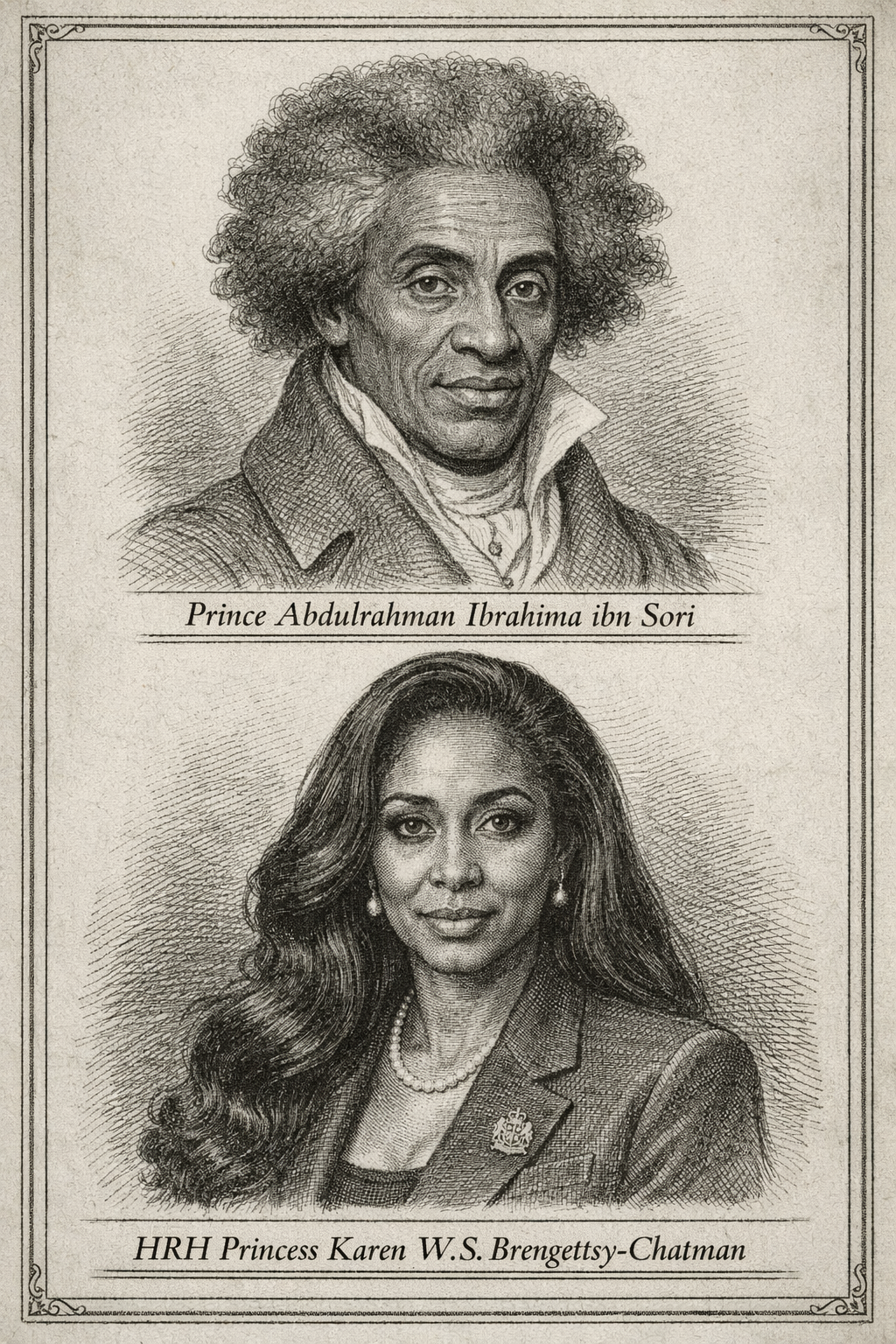
Prince Abdulrahman Ibrahima ibn Sori and HRH Princess Karen W. S. Brengettsy-Chatman
For generations, the legacies of African and African-American royal and ancestral lines have been subject to a documented pattern of erasure, distortion, and dismissal. The Official Royal House of Sori® stands today to confront this pattern directly, both as it has long affected the legacy of Prince Abdulrahman Ibrahima Ibn Sori and as it continues to affect his living descendants and other African and African-American legacy holders carrying forward documented histories of their own.
This pattern is well documented. Scholars such as Dr. Henry Louis Gates Jr., Dr. Sylviane A. Diouf, Dr. Michael A. Gomez, Dr. Ibrahima Seck, and Dr. Toyin Falola have extensively documented how African lineage, even when supported by archival evidence, oral history, and academic research, is routinely questioned or dismissed. These are not isolated incidents. They are a continuation of colonial narratives designed to diminish African sovereignty and erase African nobility, narratives that reach across generations to affect descendants today.
Prince Abdulrahman Ibrahima Ibn Sori himself lived this erasure. Born in Timbuktu and raised in Timbo, the seat of his father's kingdom in Futa Jallon, he was stripped of his name, his title, and his freedom, and enslaved for forty years before emancipation. His story survived only because his descendants, beginning with his nine children in Natchez, Mississippi, the family line known today as the Root Nine, refused to let it be forgotten. That refusal continues today.
HRH Princess Karen W.S. Brengettsy-Chatman, Sovereign of The Official Royal House of Sori® and a direct descendant of Prince Abdulrahman, has experienced this same pattern firsthand: attempts to discredit her identity and title, including claims that she uses "thousands of different names," that "The Official Royal House of Sori or Sori dynasty never existed," and even an objection raised over an institutional ZIP code. These are not isolated incidents, and they are not really about her alone. They are the same erasure that has followed African and African-American legacy holders for generations, now playing out across digital platforms instead of archives and courtrooms.
Her recent experience, in which her sovereign title was stripped, her name altered, and her grandfather's place in history misrepresented, mirrors what other African and African-American families safeguarding documented legacies continue to face. The Official Royal House of Sori® has taken immediate and decisive action to correct the record and calls for the full and permanent restoration of her title, HRH Princess, across every public platform where it was removed, not only for her, but as a precedent for every legacy holder who has faced the same.
This disparity becomes even more evident when compared to Europe. Former ruling houses across the continent continue to use hereditary titles openly and without controversy. Prince Georg Friedrich of Prussia (former Kingdom of Prussia), Prince Luitpold of Bavaria (former Kingdom of Bavaria), Princess Mabel of Orange-Nassau (Netherlands), Prince Emanuele Filiberto of Savoy (Italy), Karl von Habsburg (Austria), and Prince Jean, Count of Paris (France) all maintain their titles publicly. Their kingdoms no longer reign, yet their titles are respected, unquestioned, and preserved as cultural heritage.
What, then, is the difference between these European houses and The Official Royal House of Sori®, a historically documented African royal lineage? The difference is not legitimacy. The difference is perception, a perception that has shaped how African and African-American legacies are received long before Princess Karen or her grandfather ever entered the record.
"The continued attempts to discredit African Royality such as HRH Princess Karen W.S. Brengettsy-Chatman are not mere misunderstandings; they are part of a long and well-documented pattern of erasing African royal histories. As scholars, we possess overwhelming archival, genealogical, and cultural evidence confirming her direct descent from Prince Abdulrahman Ibrahima Ibn Sori. Any effort to deny this lineage is not an academic disagreement, it is a deliberate act of historical distortion. When individuals question her sovereign title, her identity, or even the existence of The Official Royal House of Sori®, they are participating in the same colonial mechanisms that once sought to silence African nobility. The legacy of Prince Abdulrahman is established, verified, and preserved through generations. It is not subject to public opinion, digital manipulation, or casual ridicule. As historians, we have a responsibility to confront these falsehoods directly and to protect the integrity of African royal narratives from those who attempt to diminish them," said Dr. Artemus W. Gaye.
"This has never been only about me. It is about every African and African-American family that has had to fight to be believed, to be remembered, and to be recorded accurately in a history that was never built to include us. When anyone moves to change my name, my title, or my grandfather's place in history, they are not erasing one woman. They are attempting the same erasure that has been used against our families for generations. I am not asking for permission to exist in history. None of us should have to. I will make sure my grandfather, and every family like ours, is remembered exactly as we are documented, undeniable, and free," said HRH Princess Karen W.S. Brengettsy-Chatman, President and Cultural Sovereign of The Official Royal House of Sori®.
Princess Karen noted that with discussions with both Terry Alford, author of Prince Among Slaves, and engaging with Dr. Gaye's author of Rooted Beyond Boundaries, she felt a profound sense of camaraderie, a recognition that she was not alone, neither in her family's history nor in the broader work of protecting African and African-American legacies from erasure.
About The Official Royal House of Sori®
The Official Royal House of Sori® is the authoritative cultural and administrative institution responsible for preserving the legacy, genealogy, and historical contributions of Prince Abdulrahman Ibrahima Ibn Sori. Under the leadership of HRH Princess Karen W.S. Brengettsy-Chatman, the House oversees international outreach, heritage preservation, and educational programming through The Root Nine Foundation and Institute.
Press Inquiries
Andrew Sylvester
dir_publicrelations@theofficialroyalhouseofsori.com
https://www.theofficialroyalhouseofsori.com

Legal Disclaimer:
EIN Presswire provides this news content "as is" without warranty of any kind. We do not accept any responsibility or liability for the accuracy, content, images, videos, licenses, completeness, legality, or reliability of the information contained in this article. If you have any complaints or copyright issues related to this article, kindly contact the author above.
